Every late business-to-business invoice carries statutory interest and a fixed compensation sum on top, whether or not your terms mention it. Most businesses never claim either. We recover commercial debt for UK businesses on fixed fees, so the money we get back stays yours.
An illustration, not a quote. 8% over the Bank of England base rate of 3.75%, the rate for debts where interest starts 1 July to 31 December 2026. Run it on your own invoice →
Statutory interest on a late commercial debt — 8% over base rate, by force of statute rather than by agreement
Fixed compensation on every late invoice — £40, £70 or £100 by size, plus your reasonable recovery costs above it
How long a simple contract debt stays enforceable — ledgers written off as bad are worth a second look
Nothing escalates automatically. Every step is a decision you make with the cost and the realistic outcome in front of you.
Who the debtor legally is, whether the debt is still in time, and what it is worth once statutory interest and compensation are added. A surprising number of debts are chased against the wrong company.
The formal letter setting out the debt, the interest, the compensation and the deadline — and what happens if it is missed. Most commercial debts are paid at this stage.
If they cannot pay in one go, a payment plan in writing with the interest preserved and the consequences of default spelled out. A plan you can enforce beats a promise.
If the deadline passes and the debt is not genuinely disputed, the claim is issued. That is reserved legal work, so a regulated firm does it — on the same file.
A judgment is paper until it is enforced. The route is picked to match the debtor: control of goods, a charging order, a third party debt order, a statutory demand.
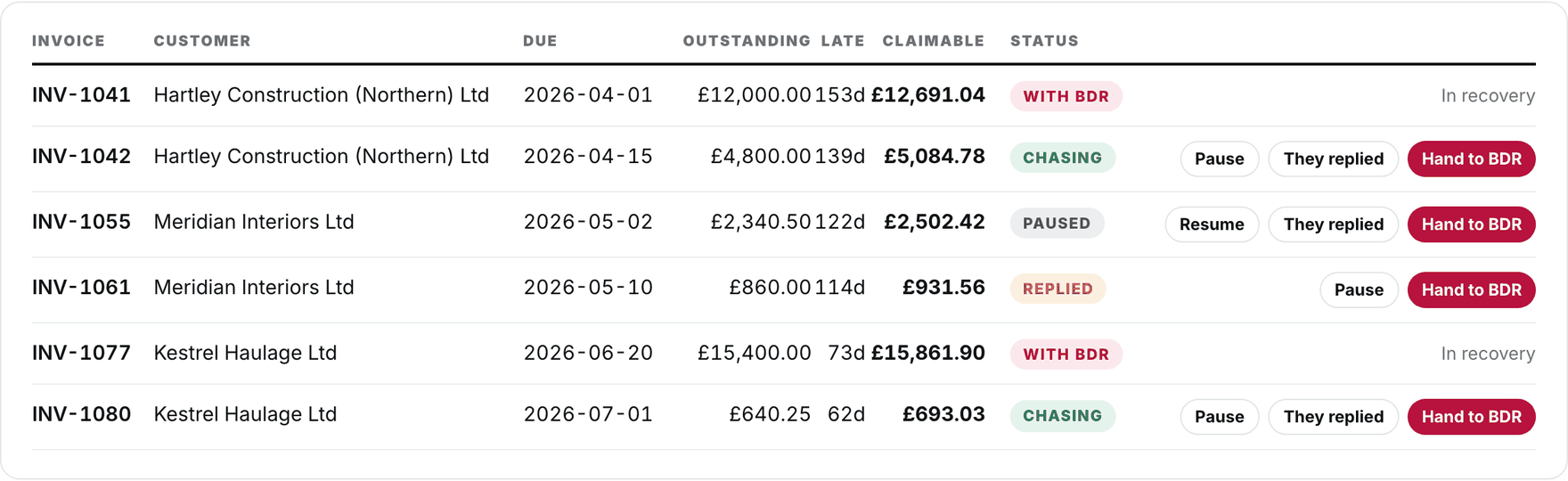
The five stages above start when an invoice has already gone wrong. Badger is our software, and it is the half that runs before that.
Your sales ledger, chased on a schedule, with the statutory interest and the fixed compensation sum already worked out on every invoice — at the rate for the date it fell due, which is the part that is genuinely hard to do by hand.
Nothing is sent until a person has read it. And when chasing stops working, any line becomes a recovery matter with one action, already costed, with the debtor already checked — the same file, and a fixed fee in writing first.
Most commercial debts are not disputed. They are deprioritised — by a customer who has worked out that nothing happens when they do not pay you.
The job of the first formal letter is to move you up their list, which is why it matters that it is precise, correctly addressed, correctly costed and visibly the last one before a claim. Vague chasing teaches a debtor that chasing is all that happens.
One unpaid invoice, or a whole aged ledger.
One invoice or a whole aged ledger, triaged so the fee attaches to the debts where it changes the outcome.
Read more →Correctly addressed to the right legal entity, correctly costed, with a deadline that means something.
Read more →Issued and conducted by AD Solicitors when the debt is not genuinely disputed and the deadline has passed.
Read more →The route that fits the debtor rather than the one that is easiest to file: control, charging orders, third party debt orders.
Read more →The strongest lawful step against a company that can pay and simply is not. Also the easiest to misuse.
Read more →Chasing your ledger on a schedule so debts resolve at 30 days instead of arriving here at 120.
Read more →Who does what, and under whose regulation. The longer version is on who we are.
Checking the debt, costing it properly, the letter before action, negotiation, settlement and payment plans. This is where most debt is recovered and none of it is reserved to solicitors.
Court proceedings are issued through them, on the same file, at a fee agreed before anything starts. Their work carries their SRA regulation; ours carries professional indemnity insurance and our own complaints procedure.
Proceedings are issued through our solicitors. AD Solicitors (SRA no. 8011228) do that part, at a fee agreed up front. You are not passed to a stranger and started again.
If a debtor has no assets, no trading and no realistic prospect of paying, spending more to chase it is throwing good money after bad. We would rather lose the fee.
No commission, no percentage of what we recover. The money that comes back is yours.
A formal final demand from a legal name, with the interest and compensation calculated and added. Most commercial debts are paid at this stage.
A different regime applies, with prescribed contents, prescribed enclosures and a 30-day clock. Getting it wrong costs you on costs later.
If the deadline passes and the debt is not genuinely disputed, the claim is issued by a regulated firm — on the same file, with us still on it.
Checking and costing the debt is free — who legally owes it, whether it is still in time, and what it is worth once statutory interest and compensation are added. You get that and a recommendation before you commit to anything.
Enforcement, statutory demands and whole-ledger work are on the full schedule. Court fees are set by the Ministry of Justice, added to the claim, and recovered from the debtor if they pay.
None of it. We work on fixed fees agreed in writing before anything starts, not commission. If you are owed £20,000 and we recover £20,000, you get £20,000.
That is a deliberate choice. Commission collectors take a percentage of money that was always yours, and they are paid most where the work was least — a large invoice that pays on the first letter costs the same percentage as one that took a year. On a fixed fee, an easy case is cheap.
Business Debt Recovery is a trading style of Buzz Legal Ltd, and AD Solicitors (SRA no. 8011228) is the authorised firm behind it. The division follows the Legal Services Act 2007.
Six activities are reserved by law to regulated firms, and two matter here: issuing court proceedings and conducting litigation. We do not do those. When a case needs them it goes to AD Solicitors (SRA no. 8011228), who are regulated and do. Everything before that point — checking the debt, the letter before action, negotiating the settlement, agreeing the payment plan — is not reserved, and that is where most debts are actually recovered.
Then you have a decision to make, and it is worth making it on numbers rather than temper. We tell you what issuing a claim would cost, what the realistic recovery looks like given what we can see about the debtor, and whether enforcement is likely to find anything.
Sometimes the answer is that the debt is not worth pursuing. We would rather say that than take a fee for a letter that will not land.
Usually yes. The right to statutory interest and the fixed sum comes from the Late Payment of Commercial Debts (Interest) Act 1998 and applies automatically to business-to-business supply contracts — you do not need it in your terms, and it can be claimed on invoices that are already long overdue.
The practical limit is the limitation period: 6 years from when the debt fell due for a simple contract debt. Interest runs from the day after the payment deadline, so an invoice outstanding for two years has two years of interest attached to it. The interest calculator will work it out at the correct rate for the date yours fell due.
Yes, including sole traders — but the process is different and we will tell you which one you are in. Where the debtor is an individual or a sole trader, the Pre-Action Protocol for Debt Claims applies: a prescribed letter of claim, prescribed enclosures, and 30 days to reply before a claim can be issued. Where the debtor is a company, that protocol does not apply and the timetable is shorter.
Getting this wrong is expensive — a court can penalise a creditor who issued too early on costs, even if they win.
The invoice, the purchase order or contract if there is one, the name of the customer exactly as it appears on your paperwork, and a short note of what has been said so far. If there has been an argument about the work, tell us — a debt with a live dispute in it is a different job and pretending otherwise wastes your money.
What each stage costs, what you can legally add to the debt, and the letter-before-action checklist. One email — we do not run a sequence.
Tell us what you are owed and who owes it. We come back with what the debt is worth once interest and compensation are added, what we would do first, and the fixed fee for doing it.