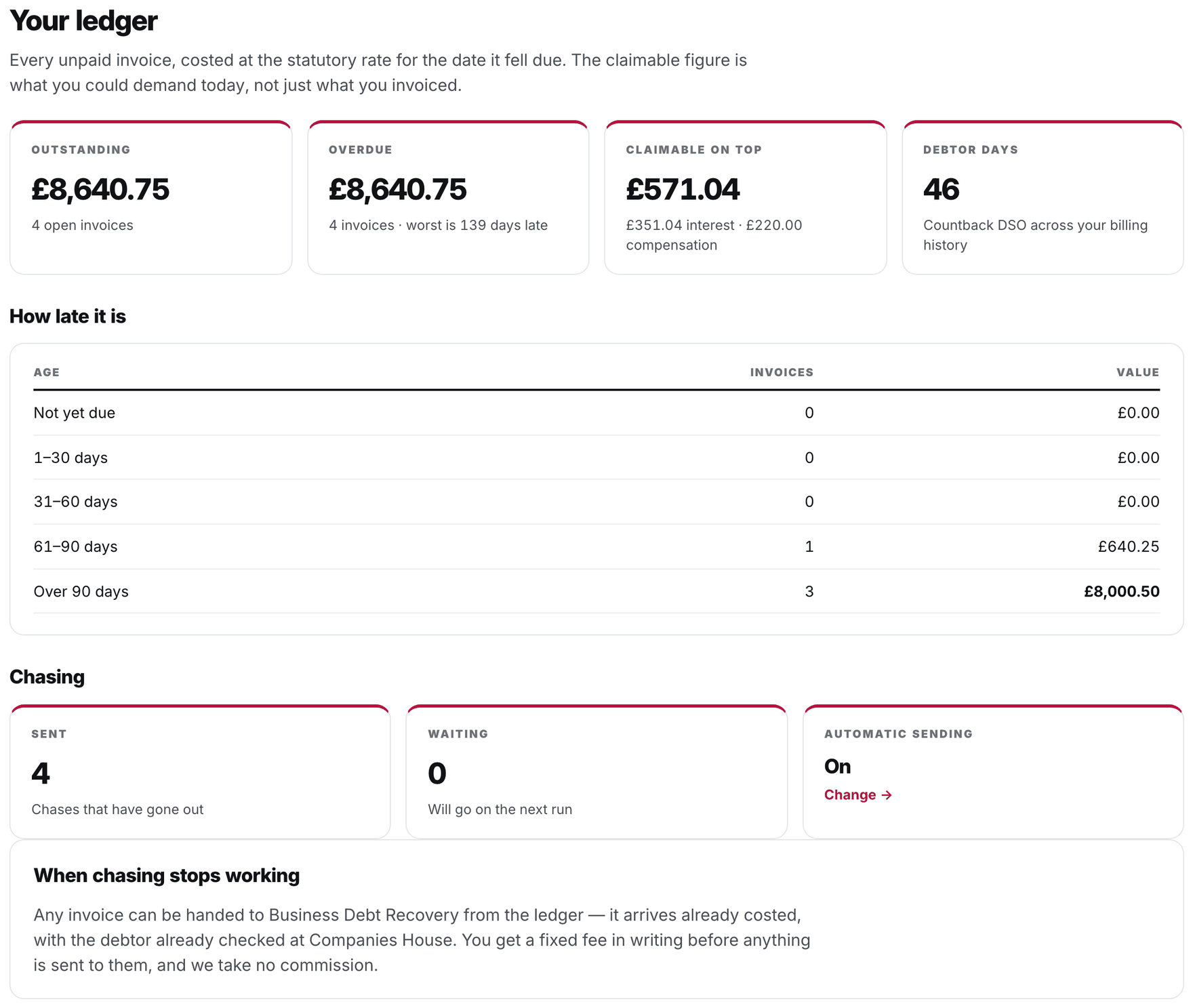
Badger runs your sales ledger, works out the statutory interest and compensation on every late invoice, and chases on a schedule in your name. When chasing has not worked, one button turns any line into a recovery matter at a published fixed fee, already costed.
The statutory rate on a late commercial invoice today — 8% over base. Badger applies the rate in force on the date each invoice fell due.
A fixed compensation sum you can add to every late invoice, by size, on top of the interest. You are entitled to it under the 1998 Act.
Every invoice is costed at the statutory rate for the date it fell due, with the fixed compensation sum added.
Chases use your templates, go out on the timings you set, and state the amount owed with interest and compensation.
Chases are held as drafts until you switch automatic sending on. You can pause any invoice or customer, and choose the first chase for an invoice that is already late.
Each chase has its own reply address. A reply stops chasing on that invoice and is forwarded to you.
Enter the date a customer says they will pay. Chasing restarts after that date if the invoice is still open.
Your payment link and bank details are added to each chase, or Xero's pay-online page for a Xero invoice. Customers pay you directly.
Each debtor's status, incorporation date, registered charges and any overdue accounts are shown on its ledger row.
Connect Xero read-only, or import an aged debtors export from Sage, QuickBooks or your own system. Badger reads your ledger and never writes to it.
Any line can be turned into a recovery matter, already costed, at any debt size. You get a fixed fee in writing before anything is sent.
Read-only Xero, or an aged debtors CSV from anything else.
Statutory interest at the rate for its own due date, plus the compensation sum.
On your schedule, in your name, with the interest and compensation stated.
Nothing reaches a customer until a person has approved it.
One button turns a line into a recovery matter at a published fixed fee.
Outstanding is the invoice. Claimable adds the statutory interest and the compensation sum, worked out per invoice at the rate for its own due date.
Each row shows its chasing status: chasing, paused, replied, or with the recovery team.
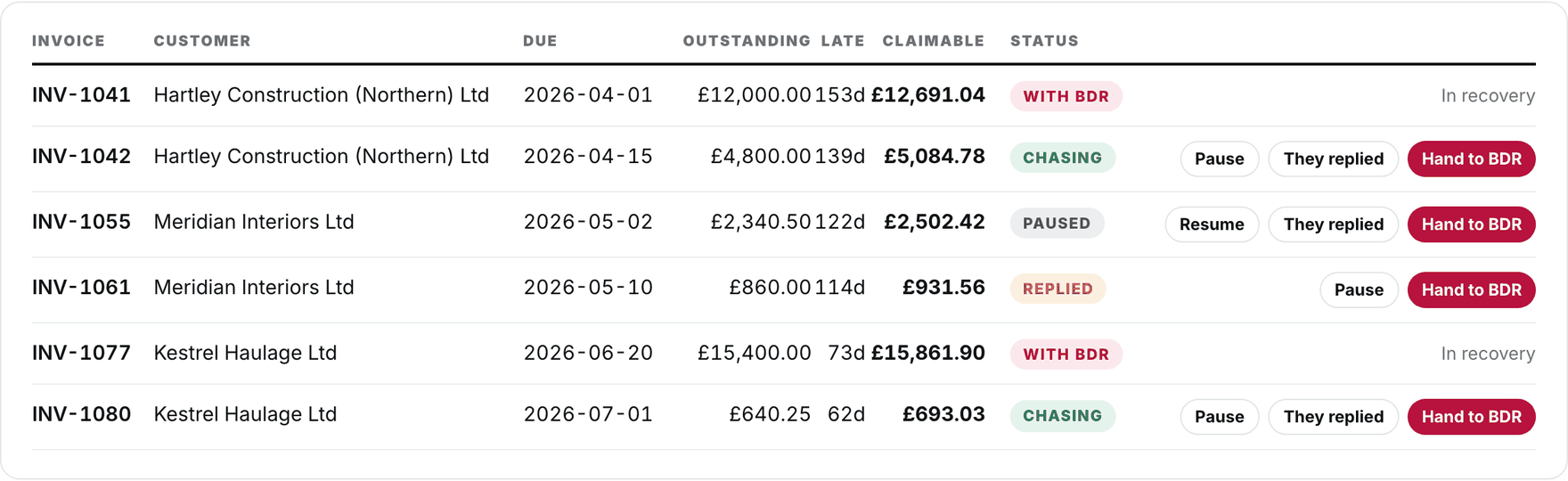
Hand over from any ledger row. The invoice becomes a recovery matter with the debt already costed and the debtor already checked.
You get the fee for the next step in writing, from the published schedule, before anything is sent. Each step needs your agreement.
One price per business covers your whole team and every invoice. You can cancel at any time.
Price excludes VAT.
Either. Run it yourself and the chases go out from your address, in your name, on your schedule, with the interest and compensation stated correctly; you keep the customer relationship and everything that is paid. Or hand any invoice to us with one action, at any point, and it becomes a recovery matter already costed with the debtor already checked. You can create an account and connect the ledger yourself, or ask us to do it with you.
You authorise a read-only connection from your own Xero and we pull the outstanding sales invoices — the customer, the invoice number, the due date and the amount still owing. Nothing is written back to your ledger, and we cannot see purchase invoices, payroll or your bank feed. You can revoke the connection from inside Xero at any time, and the access tokens are stored encrypted.
Upload an aged debtors CSV. The import reads the column names your system produces and maps the common variants used by Xero, QuickBooks and Sage. Any row it cannot read with confidence is listed back to you with the reason, because a misread due date changes the statutory rate and the amount claimed.
Yours, by default, and replies come back to you. Sending in our name is an escalation; use it when you want the customer to see that recovery has started. Chases are held as drafts until you switch automatic sending on.
Chaser and Satago offer SMS, automated calls, forecasting and connectors for more ledgers. Garfield, an SRA-regulated AI firm, takes small claims up to £10,000 through the court. Badger costs every invoice on your ledger at the statutory rate for its own due date, and hands any invoice to a recovery team at a published fixed fee, at any debt size.
You stop paying and the chasing stops. Ask and we send your ledger data as a CSV. Any recovery matter already with us continues under the fee agreed in writing for it, as a separate instruction. You can cancel at any time; there is no minimum term.
The statutory interest rule, the compensation sums and the recoverable costs, on one page with the current rate.
Tell us what you invoice from and roughly how many unpaid invoices you carry. We will connect it, agree the chase schedule with you, and show you the interest and compensation your ledger carries.